KHOIKHOI
The First Nation.
We are the Khoikhoi people. We have occupied and moved around Southern Africa as nomadic herders for thousands of years. Along with the San, we are the first inhabitants of this land. The earliest evidence of our existence can be found in traces of rock art found around various parts of Southern Africa. The Khoikhoi people are made up of four historical groupings:
Griqua | Nama | Koranna | Cape Khoi (which have further subgroupings)

WHO ARE THE KHOIKHOI?
The Khoikhoi is our original name and an umbrella term, referring to the different Khoikhoi tribes mentioned above. Variations of spelling include “Khoi”, "Khoisan" or “Khoe” (singular), as well as “Khoi-khoi”. It is noticeable that all our tribe names end in -qua (for example the Namaqua or Griqua) because -qua means “people”. The prefix refers to a historical leader and the name would therefore mean “people of the leader”. Previously, we were also referred to as the “Hottentotte”. This name represents cultural and linguistic patterns among our people. Dutch Colonialists abbreviated Hottentot to “Hot Not,” but this variation of the name carries a derogatory connotation that was carried into the painful Apartheid history. We are not formally recorded in South Africa as an indigenous cultural community. The United Nations Special Rapporteur, Prof. Rodolfo Stavenhagen documented our existence as South Africa’s indigenous peoples as the following communities listed on page 7 of the 2005 report :2.
“There are six large groups who identify themselves as indigenous and who claim this status. Under each of these groups there can be various sub-groups which differ from each other, either for their striking difference in demography or in the institutions they have adopted or again for differences in their subsistence economy. These ethnic groups include the three main San peoples (!Xun, Khwe and ‡Khomani), the various Nama communities (Khoekhoen), the major Griqua associations and representatives of the Koranna descendants, as well as several
constituencies of so-called “revivalist Khoisan”, people reclaiming their historical heritage. According to the documentation provided to the Special Rapporteur during his visit, the various indigenous groups, known collectively as Khoi-San, are estimated to include approximately 1,000 ‡Khomani San, 1,100 Khwe San, 4,500 !Xun San and 10,000
Nama people, who are mostly resident in the sparsely populated Northern Cape Province. There are a further 300,000 Griquas, mostly located in the Northern and Western Cape Provinces, but with significant communities in the Eastern Cape, Free State and KwaZulu-Natal. There is furthermore an unspecified number of “revivalists” Khoisan people associated with the Cape Cultural Heritage Development Council (CCHDC). Most of the indigenous peoples in the western part of the country were forced to adopt Afrikaans as their primary language. The use of Khoe-San languages was strongly discouraged under Apartheid.”
These historical outlines of the broad historical communities are confirmed as such in both the Status Quo reports of 1999 and the 2018 South African Human Rights Commission report on the human rights situation of the Khoisan.
The Khoikhoi peoples are known as great nomadic pastoralists, and this was our form of land economy. We were known to possess a great amount of wealth in the form of cattle, sheep, indigenous knowledge, customary resources, as well as a rich heritage. Our wealth was documented several times in colonial British, Dutch, German and Portuguese archival records. The wealth of one of the Cape Khoi tribes, the Cocoqua, is documented in one colonial record summarised from different writings as follows:
“The Kochoquas are called Saldanhars by our countrymen, because they have always dwelt mostly near and in the valleys of Saldanha Bay. They settled in fifteen or sixteen different villages, about a quarter of an hour’s distance from one another. Each village consisted of thirty, thirty-six, forty or fifty huts, all placed in a circle a little distance apart. The Saldanhars for safety kept their cattle in the centre of the village at night. They also owned a large collection of cattle, well over a hundred thousand in number and about two hundred thousand sheep, which instead of wool have longish coloured hair on the body”.
Geographically, the Khoikhoi are spread over much of the Northern, Western and Eastern Cape and the Free State, as the provinces in South Africa are known today. Prior to colonisation, all the western, southern, central and south-eastern regions of present-day South Africa were occupied only by the Khoisan peoples. As the Rooibos plant is only found in the Western Cape, the knowledge of its uses can only come from us, the original inhabitants.
Khoikhoi peoples are known for their spiritual connectedness to land. We did not regard land as an economic commodity, individually owned but rather as a gift from nature to be cared for. Therefore, we never claimed individual rights to land but lived with the deep-rooted belief that land belongs to all the living creatures that live on it. This connectedness to land coincides with the early practices and beliefs of indigenous peoples world-wide.
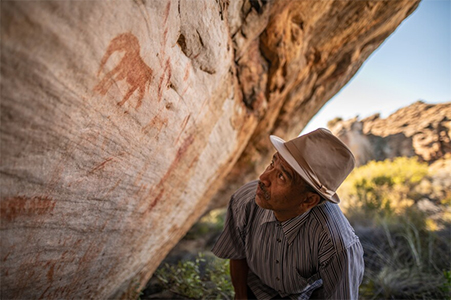
The art of painting on rocky surfaces in caves and in open lands is a unique and defining characteristic of our distinct identity and heritage. Our paintings date back thousands of years and serve as a testimony to our right to land and its resources in South Africa. Khoikhoi rock art is made up of different designs, finger dots and handprints common amongst the Khoikhoi people. The designs were applied with fingers, making a striking contrast to the work of the San.
“Khoikhoi Rock Art is comparatively rare. Nonetheless, these sites remain sacred to us and form an important part of Khoikhoi heritage today. It is regarded as the “title deeds” to our lands, resources and territories.”
Picture: Barend Salomo with Khoikhoi rock art
Our Khoikhoi ancestors continued to live as nomadic pastoralists until they experienced the dispossession of their lands and resources due to Colonialism and Apartheid, totalling over 300 years of systematic oppression.
Read more about land dispossession.
Today, we are a landless proletariat and de-Africanised, with no access to our resources, no communal land, stripped of our cultural and collective
identity, having to re-navigate our road back to a moment of collective hope.
Read more about out rebuilding.