LAND DISPOSSESSION.
Colonialism and Apartheid.
Our Khoikhoi ancestors continued to live as nomadic pastoralists until they experienced the dispossession of their lands and resources due to Colonialism and Apartheid, totalling over 300 years of systematic oppression.
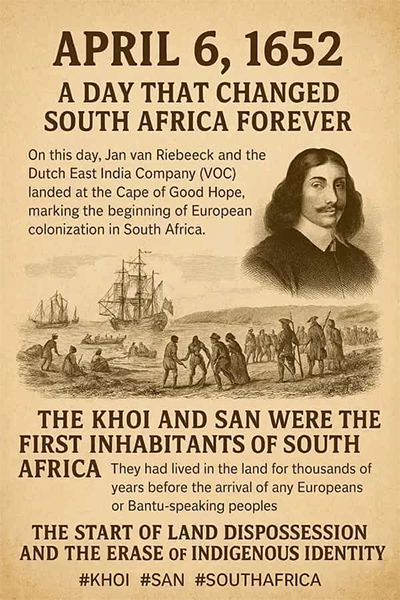
Since 1652, the Khoikhoi have been dispossessed of land by colonists.
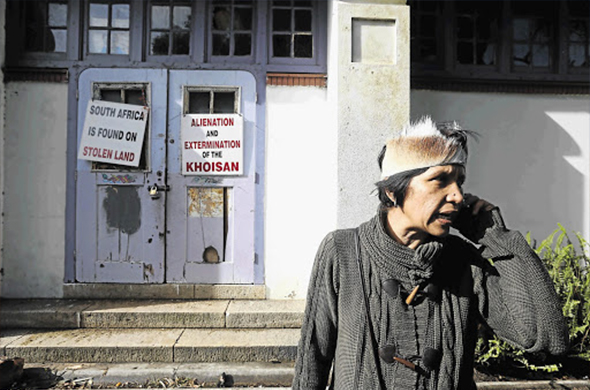
Our Khoikhoi ancestors continued to live as nomadic pastoralists until they experienced the dispossession of their lands and resources due to Colonialism and Apartheid, totalling over 300 years of systematic oppression. Since 1652, the Khoikhoi have been dispossessed of land by colonists. We were the first defenders of our land in South Africa. We, as a people, lived through three Dutch wars and genocide, slavery, indentured labour and the extreme violence that was legalised through Colonialism and Apartheid against our men, women and children. These atrocities are still largely undocumented and untold, and the Khoikhoi experience intergenerational trauma up until today. This can be evidenced through the cases of foetal alcohol syndrome our people experience on farms as informal labourers, drug abuse, general landlessness and many other social ills.
During and after colonisation, Christian missionaries came to South Africa to “civilise” the “uncivilised” indigenous people. In the Cederberg region, the missionaries destroyed our traditional and indigenous governance systems by establishing mission stations and persuading our people to unite under the auspices of the Church, and to serve God rather than continuing to live as "savages". Our beliefs, ways of life and indigenous systems developed over thousands of years were relegated to that of mere savagery.
The relegation of our indigenous “beingness”, and its replacement with Christianity, totally undermined our indigenous cosmologies and worldviews. In order to sustain the mission stations, the missionaries required colonial governments to register Khoikhoi land in the name of the Church, thus furthering our land dispossession. Instead of striving towards fairness, justice and equality for Khoikhoi people, the Church only believed that they should baptize us and convert us into Christians. We believe that they did not convert us into Christians but, rather, into Christian slaves and thereby, totally disrupted and destroyed our customary systems and practices.
“The Catholic faith and the Christian religion be exalted and be everywhere increased and spread, that the health of souls be cared for and that barbarous nations be overthrown and brought to the faith itself. Any land not inhabited by Christians is available to be "discovered," claimed, and exploited by Christian rulers.” - Doctrine of Discovery in Europe, 1493.
We were also systematically oppressed by multiple colonial governmental Codes. The Hottentots Code of 1809 (also known as the Caledon Code), as well as the Masters and Servants Act of 1856 were introduced after the abolishment of slavery to ensure the supply of labour on the commercial farms. The Hottentots Code made it illegal for the Khoikhoi to own land and forced them to have a fixed ‘place of abode’ on either a farm or a mission station. It also stated that if a Khoikhoi wished to move, he had to obtain a pass from his master or from a local official.
The Hottentots Code was one in a series of pass laws used to empower the Afrikaner farmers to control the Khoikhoi peoples’ movements. If we were caught without such a pass, we would be arrested. This became the systemised recruitment for the prison system we still find today. This prison system served to dehumanise our men and youth. These prisons systems, especially in the Western Cape, served as free labour for Afrikaner commercial farmers. Both the farmers and the prison resources were legally used to support the Afrikaner farms under apartheid. These are lived stories our people still carry.
In the Western Cape, there are 18 prisons, and the Khoikhoi form the majority of all the prisons’ populations. This social composition of the incarcerated population has been consistent for over 200 years. The different Codes were, therefore, used as a legal and moral justification for the colonial dispossession of our sovereign indigenous people from their lands and resources.
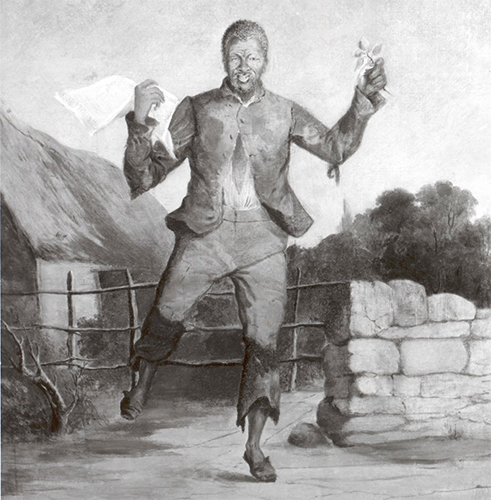
Nowadays, many of our Khoikhoi descendants continue to find themselves as farm labourers on commercial farms that they hold deep ancestral claims to. They hold no real land and resource rights on these farms, other than some residential rights and informal employment. The post-Apartheid Land Restitution Programme in South Africa did not benefit our communities meaningfully. The government reopened the restitution opportunities in 2014 through the passing of an Amendment to the Land Restitution Act. Unfortunately, a constitutional court judgment was handed down in 2016 which put an end to the Khoisan’s second potential opportunity to land restitution by ruling the Amendment Act unconstitutional. Until the legislature can pass new restitution legislation, the Khoikhoi and San cannot institute land claims.
The Apprentice Act (1812) made it legal for a farm owner to remove a Khoikhoi child from its parents and transfer the child to any farm where labour was needed. Between the ages of six and twenty-seven, that child was then required to be under the employment of the farm owner. Some reports to the Magistrates Courts at the time shows there was little regard to allowing these children out of this servitude even upon reaching the age to be freed. Some publications estimate that well over 2000 Khoisan children were removed from their parents over that period.
A further key social legacy the Khoikhoi community continues to face is that of the “dop system” (drink system). It was a system prevalent on the wine farms in the Western Cape, where the commercial farmer would, alongside daily wages, pay the farm workers with cheap wine as a fringe benefit. This system exacerbated and dramatically increased the alcoholism among farm workers, which caused deep social damage which is felt up to today. Foetal alcohol syndrome amongst these communities is seven times higher than the world average. In post-Apartheid South Africa, former president Nelson Mandela’s administration ended this practice by outlawing it.
With the Apartheid system arriving, our indigenous identity was further disrupted through the Race Classification Act and the Populations Registration Act, whereby South Africa created race categories of (i) White (ii) African (iii) Indian and (iv) Coloured. The Khoisan were then forcibly classified as “Coloured”, a label which further dispossessed us from our African beingness by severing the last connections to our customary resources and knowledge (as confirmed by the United Nations Mission Report to South Africa in 2005). Everyone who did not fall into one of the other categories was then subclassed under the term Coloured, thereby destroying any notion of common African heritage.
The forced removals under the Group Areas Act of 1950 marked yet another era of forced removals from areas we occupied, this time in town areas. The spatial disruption was thereafter clearly marked along racial lines. For instance, in Cape Town, the Coloured community was removed from what constituted 16 magisterial districts along Table Mountain range. All these areas were found along the foothills of the Hoerikwaggo mountain, today called Table Mountain, a world heritage site. These communities were removed to what is today the Cape Flats: a crime ridden, impoverished wetland area with extreme social and economic challenges, neglected in terms of government development priorities.
The Khoikhoi is our original name and an umbrella term, referring to the different Khoikhoi tribes mentioned above. Variations of spelling include “Khoi”, "Khoisan" or “Khoe” (singular), as well as “Khoi-khoi”.
Find out who the KhoiKhoi are.
Today, we are a landless proletariat and de-Africanised, with no access to our resources, no communal land, stripped of our cultural and collective
identity, having to re-navigate our road back to a moment of collective hope.
Read more about out rebuilding.